David Beckham retired in 2013。a decade before Kylian Mbappe lifted the World Cup trophy as a 19-year-old phenomenon. Yet the two names share a peculiar trajectory—both became global icons not solely for their on-pitch exploits but for how they navigated the commercial, cultural, and tactical currents of their eras. Beckham and Mbappe represent two distinct models of footballing stardom, and examining them side by side reveals how the sport's relationship with celebrity, speed, and strategy has shifted.Beckham's game was built on precision. His crossing ability, dead-ball mastery, and relentless work rate defined a midfielder who never relied on explosive pace. Watch his 2001 free-kick against Greece—the last-minute equalizer that sent England to the World Cup—and you see a player who practiced the same set-piece thousands of times until it became muscle memory. Mbappe。by contrast, operates on acceleration and spatial awareness. His 2022 World Cup final hat-trick, including two goals from open play, showcased a forward who thrives in transition, exploiting half-seconds that defenders cannot recover. The difference is not just physical but philosophical: Beckham engineered moments through repetition;
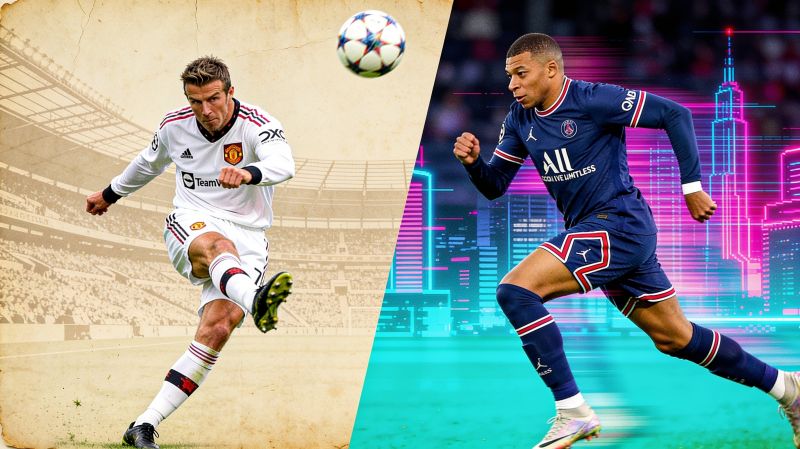
Mbappe seizes them through instinct.Their off-pitch influence diverges even more sharply. Beckham and Victoria Adams' marriage in 1999 turned him into a tabloid fixture, a brand ambassador for sunglasses and underwear, and eventually an MLS trailblazer with LA Galaxy. His move to America was ridiculed by purists, yet it paved the way for Major League Soccer's expansion and global reach. Mbappe。meanwhile, grew up in the social media age. His 2018 transfer to Paris Saint-Germain for €180 million made him the most expensive teenager in history, and his contract negotiations with Real Madrid became live news cycles watched by millions. Beckham built a brand through curated image;Mbappe was born into one where personal data, endorsement deals, and political stances are inseparable from athletic output.Consider their international careers. Beckham captained England through three major tournaments, often carrying the weight of a nation's expectations—sometimes literally, as in his 1998 red card against Argentina that made him a scapegoat until his redemption in 2002. Mbappe won the World Cup at 19, scored in the final at 23, and has already surpassed Thierry Henry's national team goal record. The pressure differs in kind: Beckham faced a media ecosystem that demanded public contrition and private stoicism;Mbappe faces a 24-hour news cycle that amplifies every gesture。every contract clause, every subtle shift in body language on the bench.What unites them is adaptability. Beckham reinvented himself from Manchester United's midfield engine to Real Madrid's Galáctico to LA Galaxy's marketing centerpiece to AC Milan's brief rental—each move requiring a recalibration of his role. Mbappe has already shifted from Monaco's breakout star to PSG's focal point to Real Madrid's marquee signing, learning to share space with Vinícius Júnior and Jude Bellingham. The Beckham and Mbappe comparison isn't about who is greater;
it's about how footballing greatness gets manufactured, marketed, and remembered. Both men understood, early, that the game extends beyond ninety minutes. That insight。more than any free-kick or sprint, is their shared legacy.